

Last June, Iran threatened to activate “sleeper cells” on American soil days before President Trump ordered strikes on its nuclear facilities. While this threat failed to materialize at the time, it has led to renewed worries about potential homeland attacks in the aftermath of successful U.S.-Israeli airstrikes that have decimated Iran’s regime leadership.
Despite this, there has been a dearth of easily accessible information about Iranian migration to the U.S. that would allow us to make informed decisions about security and humanitarian matters. To fix that, I built an interactive dashboard that tracks Iranian irregular migration across the Western Hemisphere in near-real time, pulling from government databases in Brazil, Colombia, Panama, Honduras, and the United States.
Here are the five things that matter most right now.
Encounters with Iranian nationals have virtually collapsed since Trump took office.
Since 2000, Customs and Border Protection (CBP) has recorded roughly 2,180 encounters with Iranian nationals. This is a small flow by any measure, but it grew from 50 annual encounters in Fiscal Year (FY) 2021 to a peak of 800 in FY 2024.
This pattern was mirrored throughout the Americas. In January 2025, transit countries recorded 452 Iranian migrants across the corridor — Colombia alone saw 180. Four months later, the combined total was 17. Colombia’s count fell to zero, Honduras dropped from 78 to 3, and Mexico went from 76 to 6.
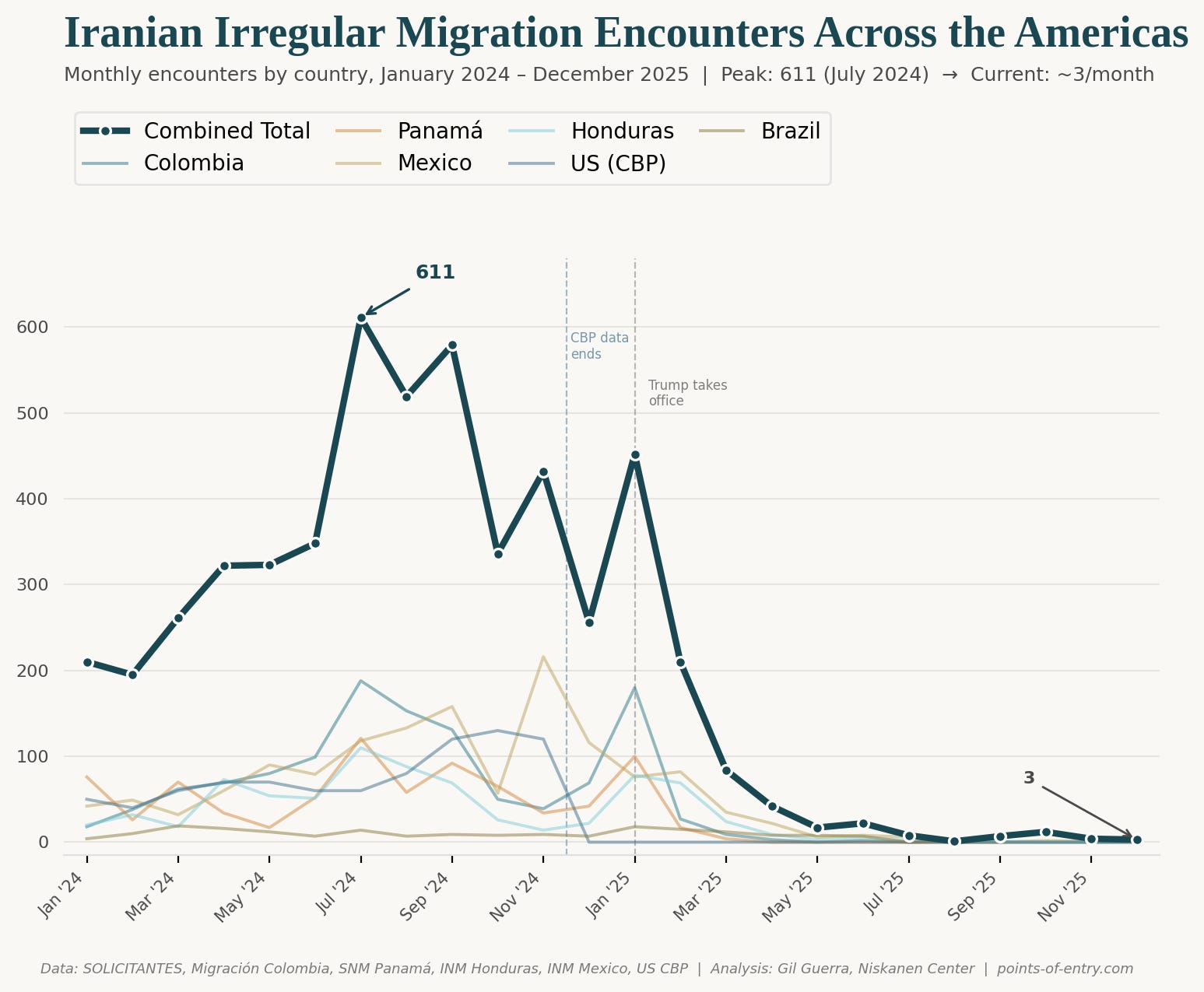
Enhanced enforcement measures at every step of the journey have practically brought irregular Iranian migration through the Americas to a halt.
Recent strikes are unlikely to create a surge of Iranian migration to the U.S.
This collapse is unlikely to reverse itself even if a large number of Iranians choose to leave Iran in the coming months. The trip to the U.S. is estimated to cost tens of thousands of dollars, and as we’ll see, the likelihood of a successful asylum outcome is low.
Other countries, such as Turkey, Germany, and Canada represent far likelier options given their relatively cheaper costs, easier logistics, and clearer pathways. In the Americas, a small number may choose to apply for refugee status in Brazil or Argentina, but those seeking to do so with the intent of crossing by land to the U.S.-Mexico border will face steep odds.
Three scenarios are worth tracking. With the present enforcement measures in place, I expect the corridor to stay closed and Iranian flows to remain near zero. If one or two countries miss a surge of migrants, small upticks could follow but would be contained by remaining bottlenecks elsewhere. Even a full-scale displacement event from Iran would likely fall within historical parameters, with a ceiling of about 600 total encounters across all sources.
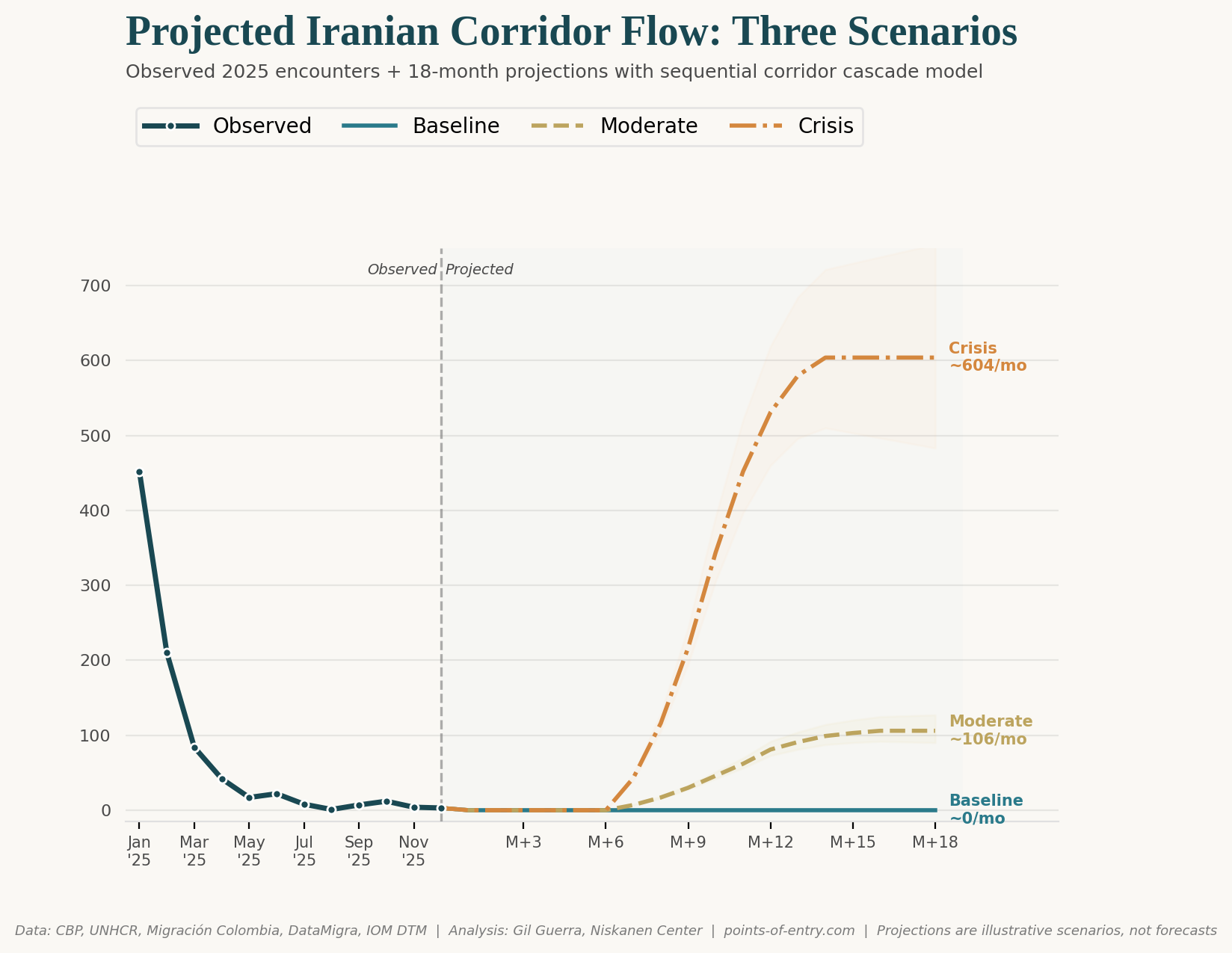
The security scenario policymakers should be worrying about isn’t a sudden rush of Iranian migrants arriving in the Americas.
The real security threat comes from established passport forgery practices.
The Iranian nationals who appear in this data carried Iranian passports, submitted to processing voluntarily, and identified themselves as Iranian. Screening these individuals is a manageable task for a competent border security apparatus, and they likely represent genuine humanitarian and economic migrants.
A more serious problem lies in the ongoing practice of passport forgery by Iranian smuggling rings. In April 2023, Brazil’s Federal Police disrupted a smuggling operation that moved Iranians through the hemisphere on forged Canadian passports — a full-journey operation with costs running into the tens of thousands of dollars per person. In an earlier case, seven Iranians were intercepted at the Brazil-Peru border carrying forged Israeli, Danish, and Canadian documents. Investigative reporting has identified the Tri-Border Area as a hub for Iranian document forgery networks, with fraudulent documents costing up to $60,000.
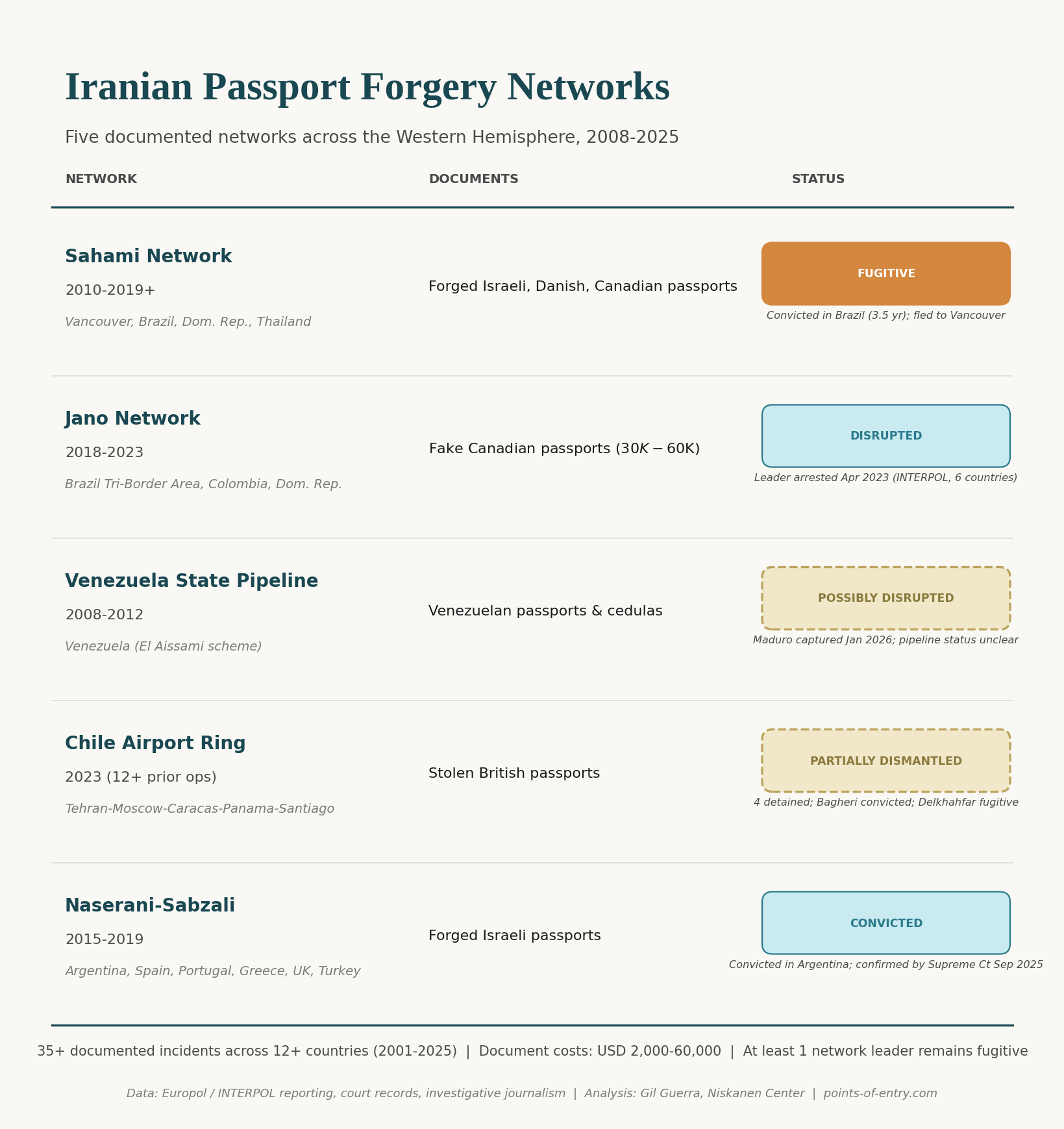
While asylum seekers who do appear in the Americas should be vetted, security resources would be better spent on document fraud detection, international law enforcement cooperation, and disruption of the smuggling networks that facilitate covert entry.
Most Iranian migrants are middle-aged men, some appear to be Afghan in origin.
The demographic profile of Iranians encountered across the corridor is narrow. Between 68% and 77% are male, depending on the transit country; two-thirds are over 30, and about 10% are minors.
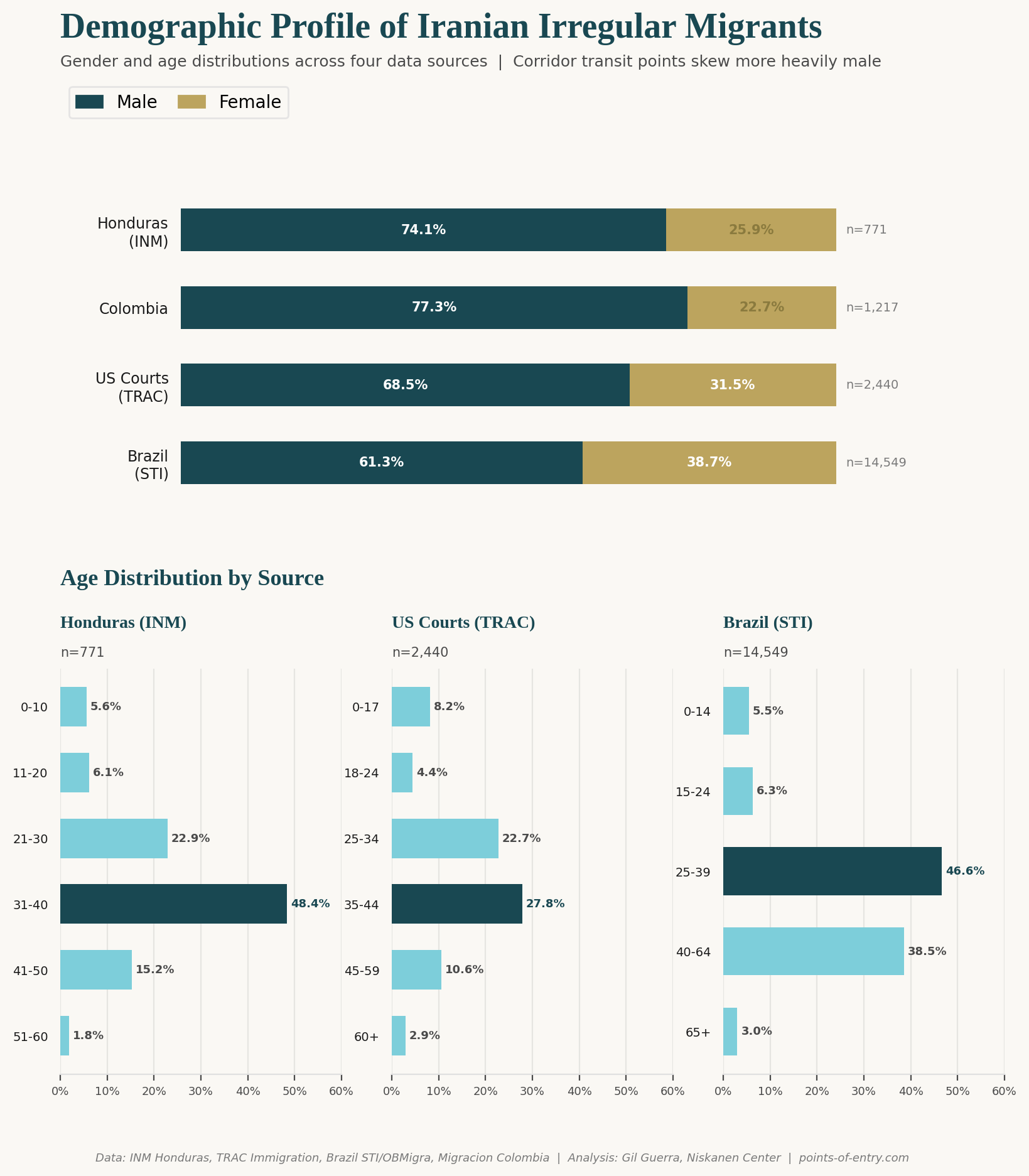
Interestingly, the share of Dari speakers among Iranian-documented migrants in US immigration courts has been roughly 10% in the past two fiscal years. Dari is the primary language of Afghanistan, not Iran. A share of people presenting Iranian documents appear to be Afghan nationals who resided in Iran, a population of over three million.
Iranian asylum seekers face a tougher pathway.
The small number of Iranians who reached US soil before the corridor closed now face a sharply different adjudication environment.
In FY2024, immigration courts granted asylum to 85.6% of Iranian applicants. By the first quarter of FY2026, that rate had fallen to 27.0%, a drop of nearly 59 percentage points in under two years. Denial rates climbed from 14.4% to 73%.
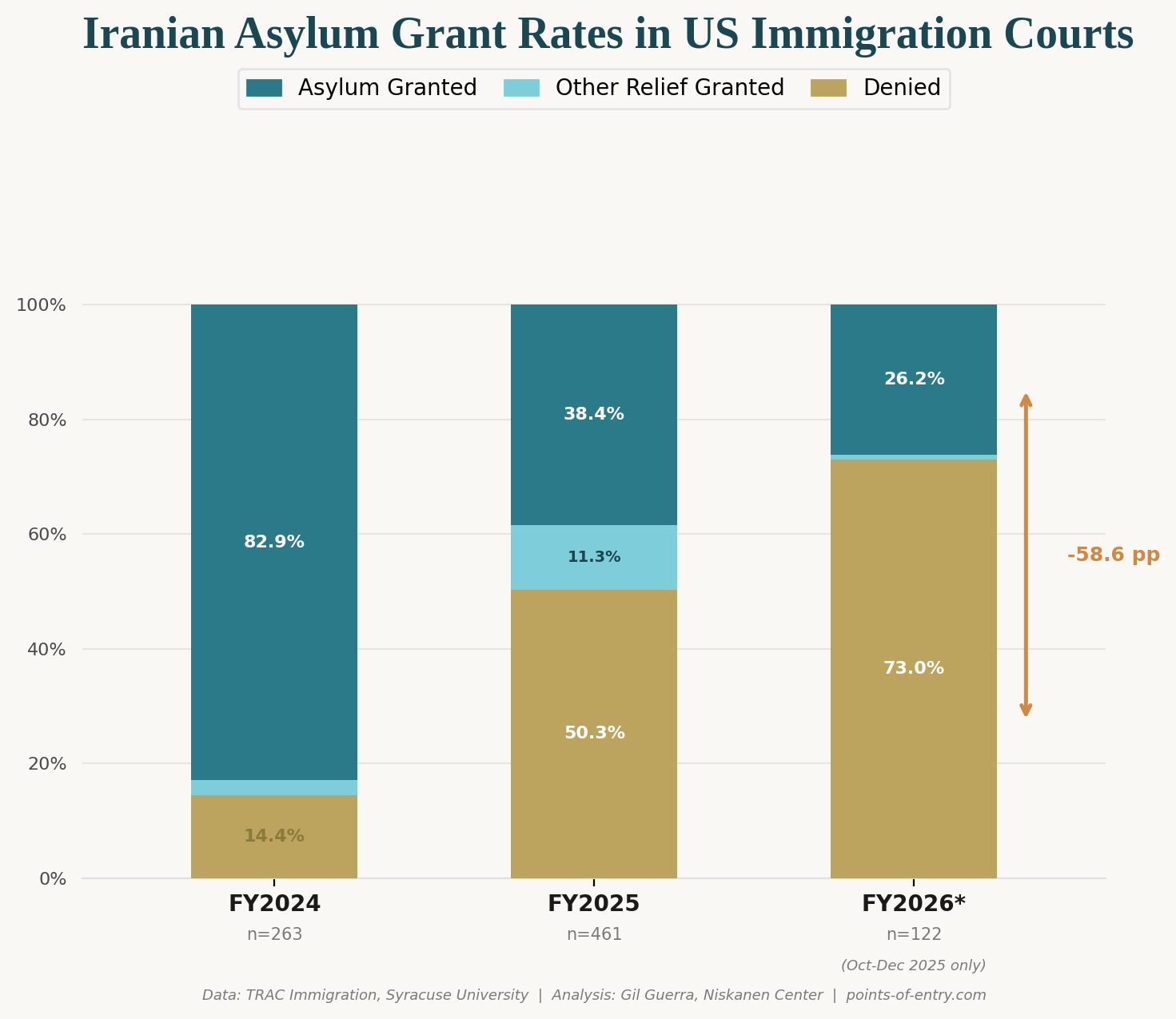
The sample sizes are small (263 cases in FY2024, 122 in early FY2026), but the trajectory is clearly moving in the direction of increased denials.
The dashboard will continue to track these flows as conditions develop. The indicators to watch are Brazil’s airport entry data, Colombia’s transit numbers, and Honduran irregular encounter numbers. If displacement from Iran to the Western Hemisphere accelerates, those are where it will appear first, and the data from those sources will tell us whether the enforcement architecture holds or whether the corridor finds a new shape.