

Wyoming is known for very few things. It has the fewest people of any state, produces the most coal, and was the last state to raise its legal drinking age from 19 to 21.
Wyoming can now add another entry to its list of fun facts: According to my research, it had the highest rate of second-generation outmarriage of any state from 1880—1930.
As detailed in the previous posts in this series, my research measures historical assimilation by looking at how the children of immigrants in the United States chose to marry. After compiling millions of census records across six decades, I analyzed how many second-generation Americans chose to marry someone from a different immigrant community or whose family had been in the United States for at least two generations.
This entry focuses on how second-generation marriage patterns varied by geography, a topic I recently explored in a piece for City Journal. You can read that piece by clicking on the button below, or see a summary with graphics here.
Outmarriage was high in the South and the West, low in the Southwest, the Midwest, and the Northeast
Marriage patterns followed a surprisingly consistent regional divide but had some puzzles. After adjusting for the local concentration of second-generation Americans, the Coastal West had some of the highest rates of outmarriage while the Southwest had the lowest. The Mountain West significantly overperformed the neighboring Midwest, while the Deep South saw higher rates of outmarriage than the putatively cosmopolitan Northeast.
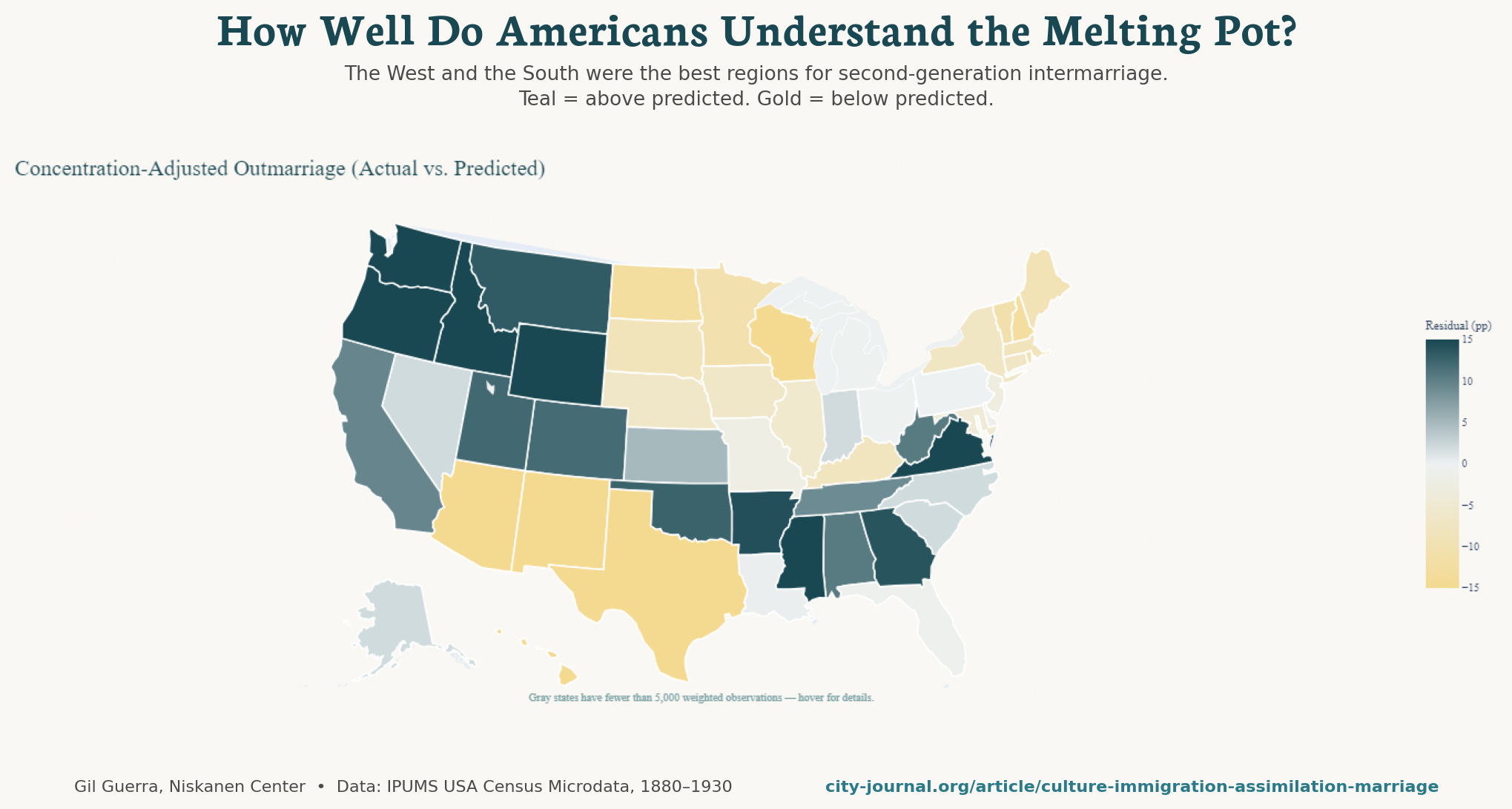
The states with the highest rates of outmarriage were Wyoming, Oregon, and Washington. The states with the lowest were Hawaii, Arizona, and New Mexico.
Some of this variation can be explained by small sample sizes and unique circumstances. In Hawaii many second-generation Americans were of Japanese heritage, who married within the Japanese American community at exceptionally high rates.
New Mexico, Wyoming, Idaho, and Arizona also had relatively small sample sizes. If we limit ourselves to states with large sample sizes, the top three states for outmarriage were Oregon, Washington, and Utah, while the bottom three were Texas, Wisconsin, and North Dakota.
Why was the West better for assimilation?
Three factors likely contributed to the West’s overperformance on outmarriage. First, there were plenty of young single men in these states during this time period but not as many young single women. This meant that the men couldn’t be too choosy about their partners, and as I covered in part 1 of this series, men were more likely to marry outside of their ethnic communities to begin with.
Second, the Coastal and Mountain West represented a more individualistic culture and new beginnings. In contrast, the ranching culture of the Southwest often led to tight kinship networks that were difficult to penetrate.
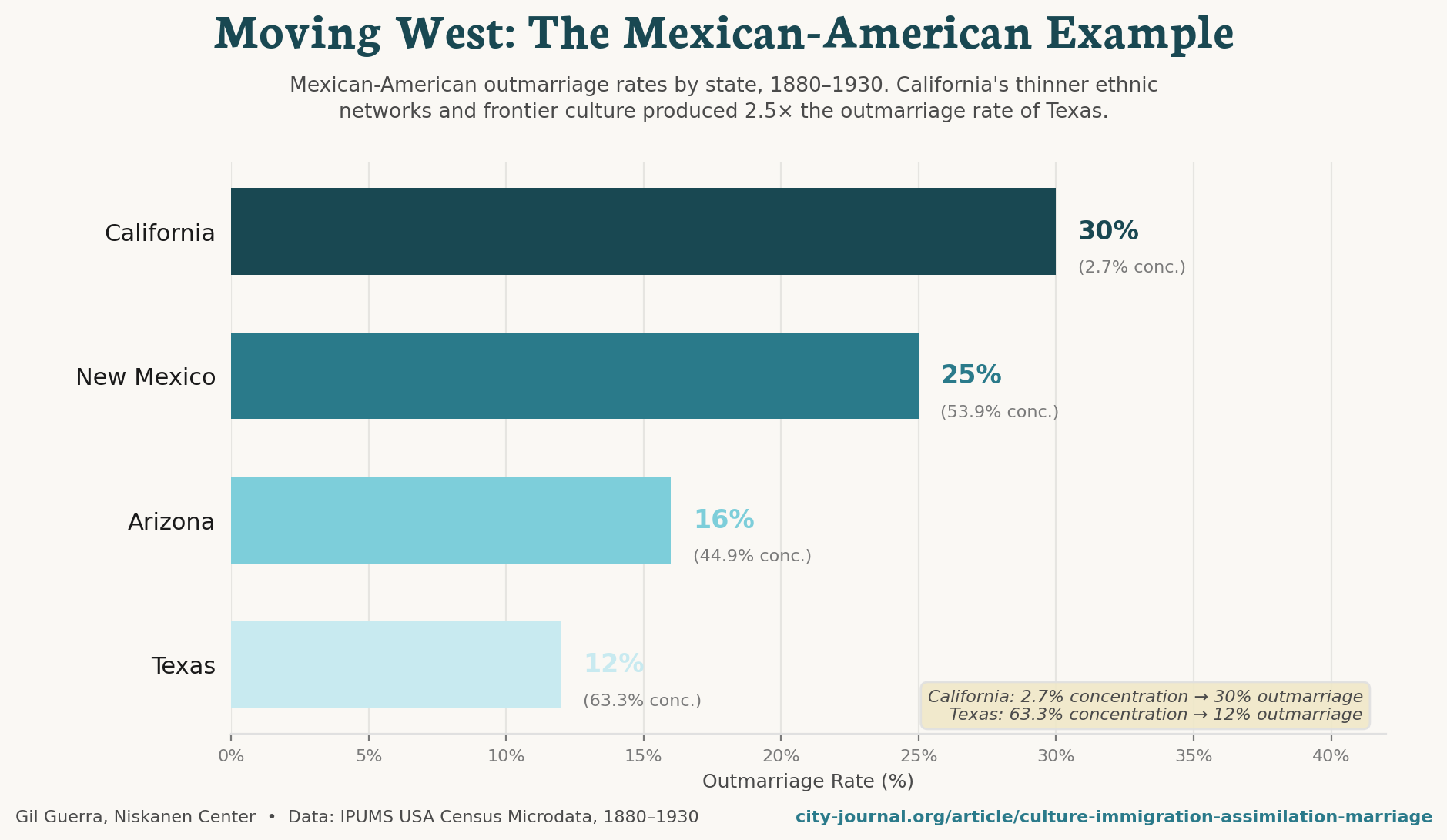
This had an effect even for notably insular groups. Mexican Americans had the lowest outmarriage rates of any major ethnic group in the data, but moving West had a significant effect. On average, only 17% of Mexican Americans in the Southwest married outside of their community. In California, 30% did.
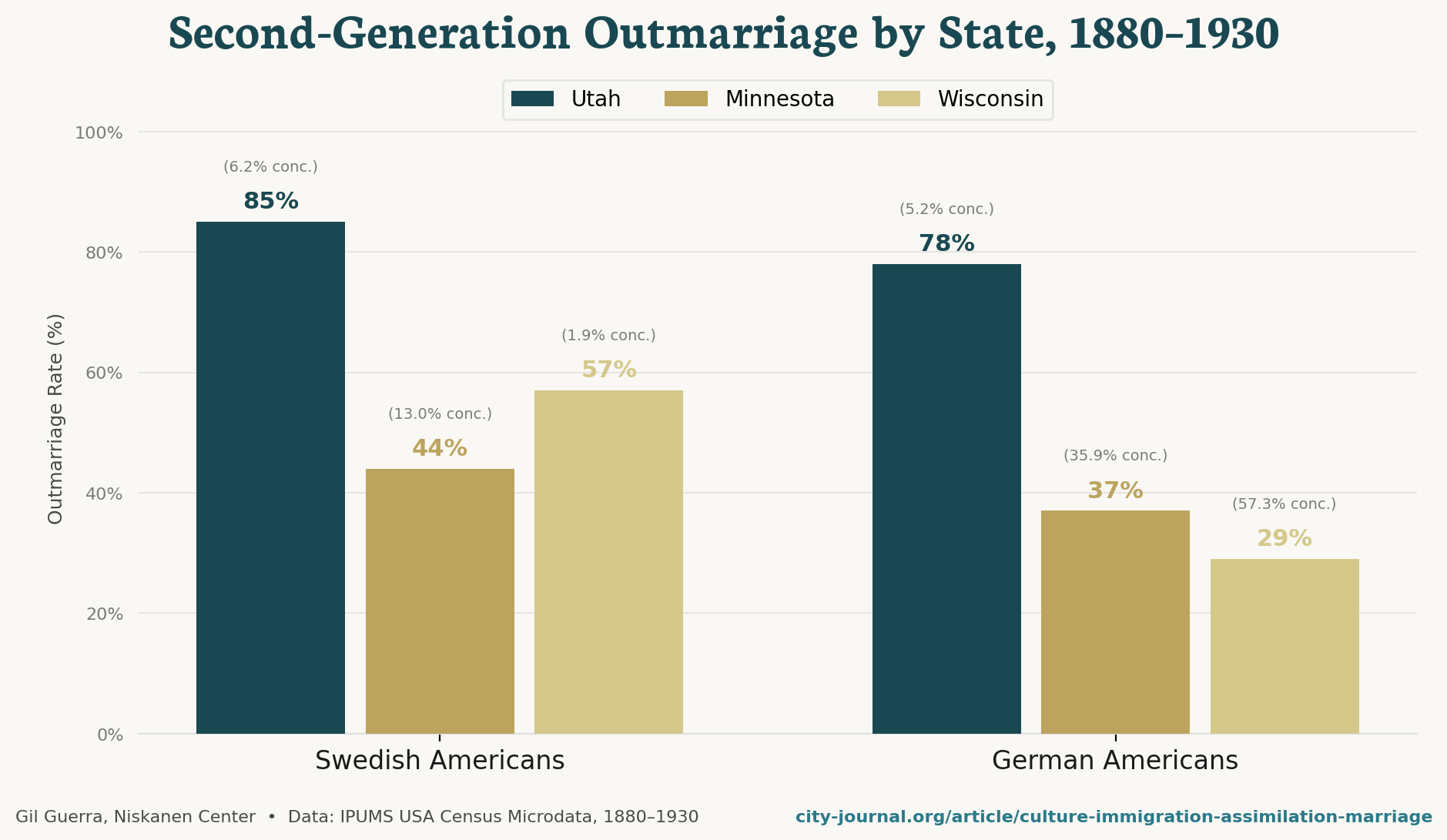
The West also benefited from having a relative lack of immigrant and ethnic institutions. One of the only institutions in the Mountain West was the Mormon church, which seemed to break down ethnic barriers among its second-generation adherents. Continental Northern European groups like Swedish and German Americans tended to have higher outmarriage rates in Utah than they did in Midwestern states, where religious denominations often carried ethnic associations.
What about the South and the Northeast?
As in Utah, the Deep South’s high rates of second-generation outmarriage can partially be explained by a strong local culture that gave immigrants there something to assimilate into.
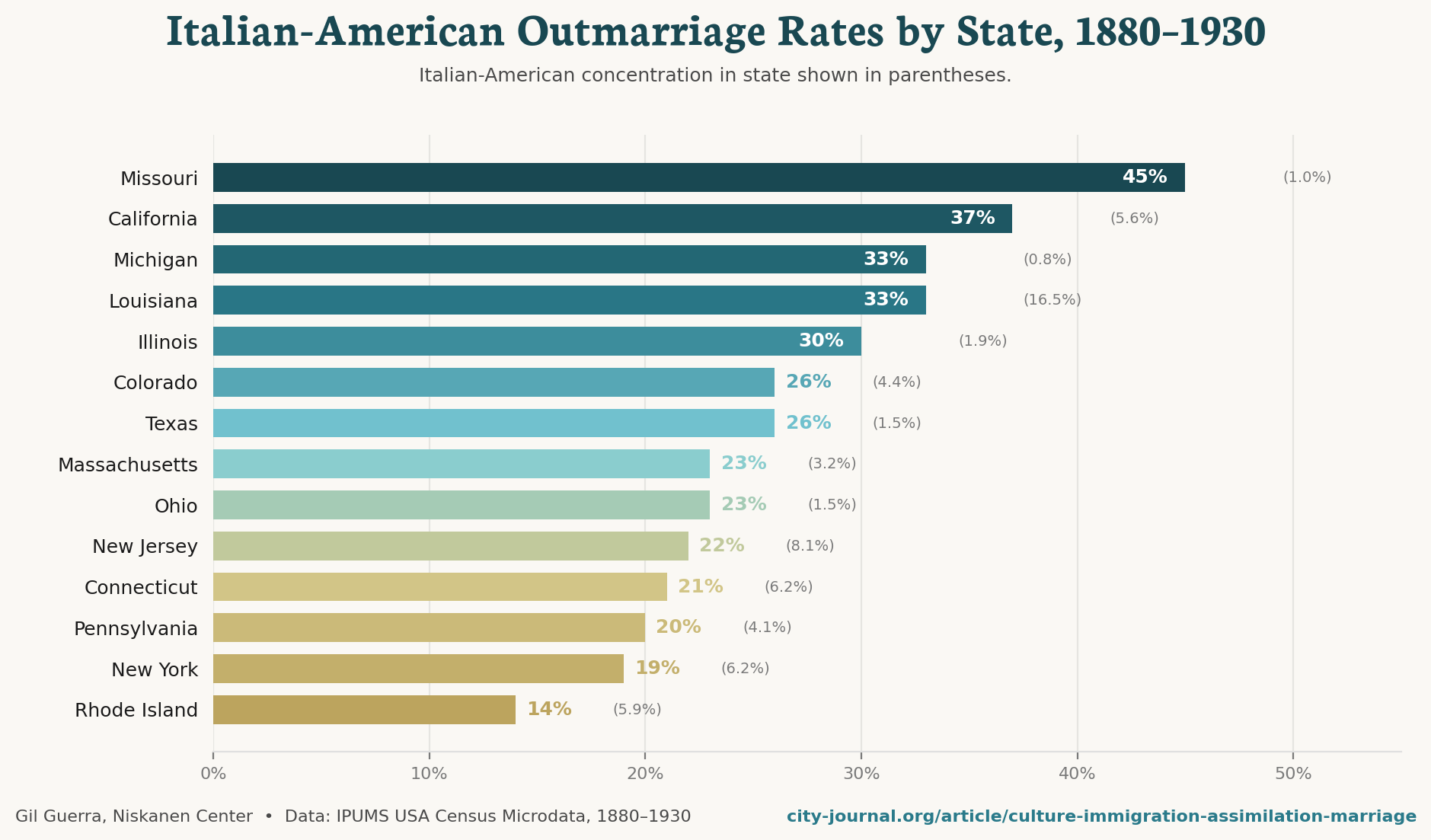
The South’s effect was best reflected in the outmarriage rates for Italian Americans, who were much more likely to marry outside of the Italian American community in places like Louisiana or the quasi-Southern state of Missouri than they were in places like Rhode Island or New York.
The Northeast had a distinct regional culture as well, but various factors created immigrant community enclaves that slowed outmarriage and other forms of assimilation.
These findings all reflect loose, general patterns and not hard or eternal truths. In my City Journal piece, I discuss the implications this research has for contemporary assimilation. Read it here, and subscribe to Points of Entry to get the final installment in this series in your inbox when it comes out.